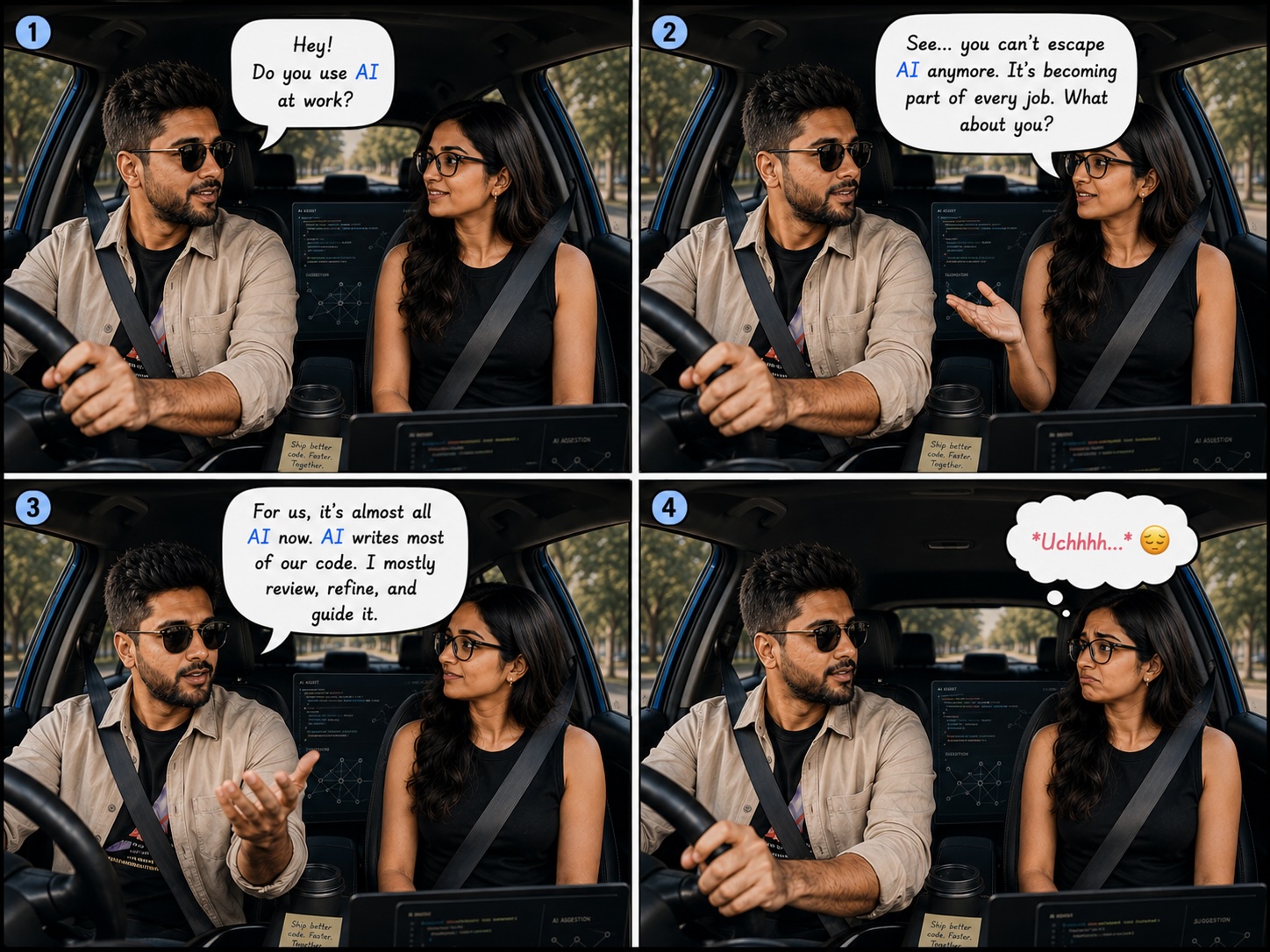
While driving to the office, I was discussing the role of AI in our jobs with a non-technical friend.
Me: Hey! Do you use AI at work?
Her: See... you can't escape AI anymore. It's becoming part of every job. What about you?
Me: For us, it's almost all AI now. AI writes most of our code. I mostly review, refine, and guide it.
Her: Uchhhh... 😔
She genuinely felt sorry for software engineers.
At that moment, I didn't know how to respond.
But that "Uchhhh..." stayed with me.
It made me realize how many people see AI as taking jobs instead of changing jobs.
On the rest of the drive, I kept thinking about how I could explain this shift to her—or to anyone outside tech.
That's what inspired me to write this post.
This isn't the first time humanity has experienced such an evolution.
People once did all physical labor manually. Then machines took over much of that work. Humans didn't become obsolete—we moved on to designing, operating, and improving those machines.
When cars replaced horse-drawn transportation, horses were no longer the primary mode of transport. Society didn't stop moving; it moved faster.
Software engineering is going through a similar evolution.
Writing code line by line was never the goal.
Solving problems was.
Today, AI generates much of the code. Engineers spend more time understanding problems, designing solutions, reviewing outputs, making trade-offs, and ensuring quality.
The manual work is being automated.
The intellectual work is becoming more valuable.
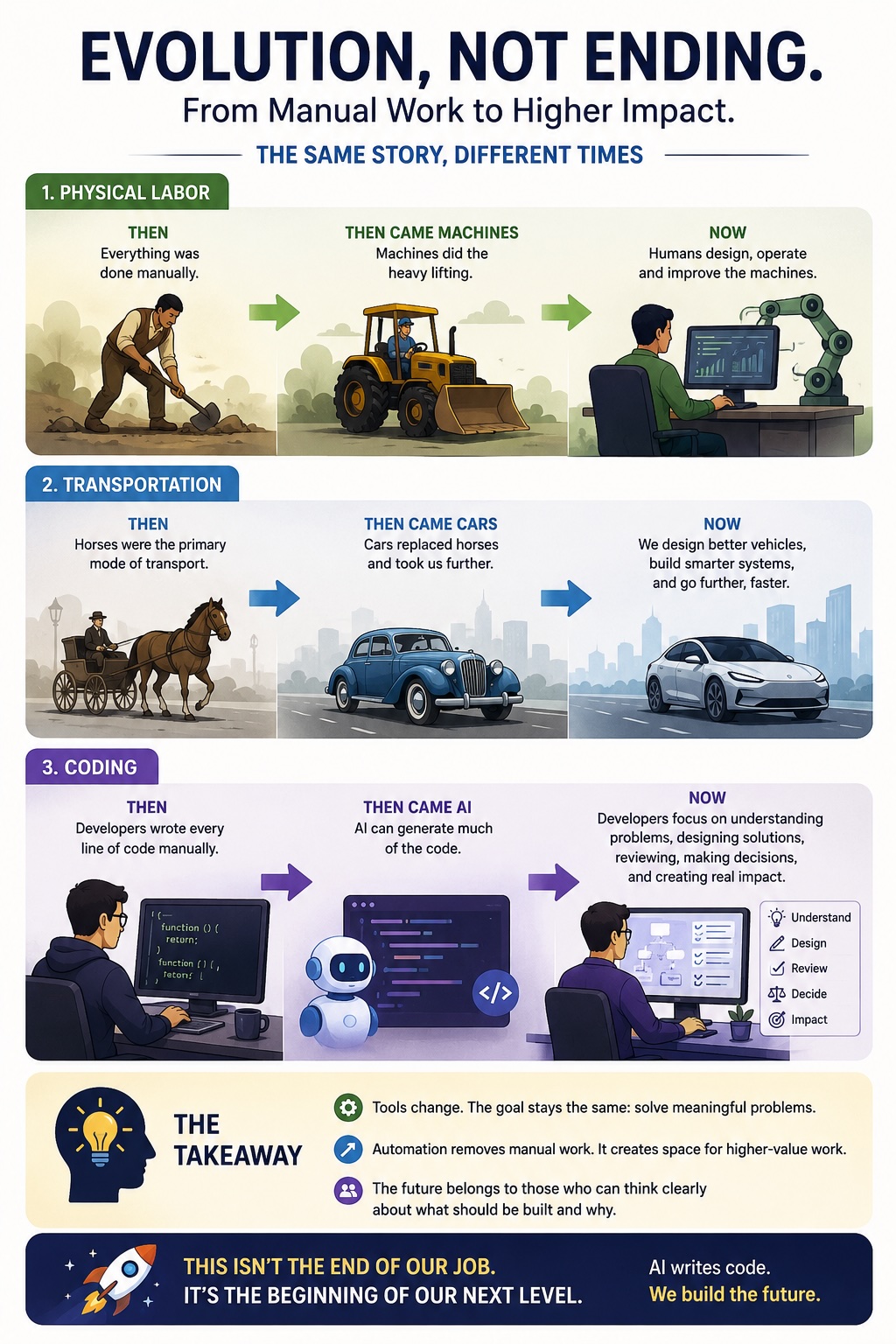
Just as calculators didn't replace mathematicians, AI won't replace engineers. It will raise the level at which engineers operate.
Nice explanation