
A few years ago, being a good software engineer meant writing clean code, mastering frameworks, and remembering APIs.
Today, AI can write code, generate tests, explain stack traces, and even review pull requests.
So how should engineers approach software engineering in the age of AI?
The framework is simple:
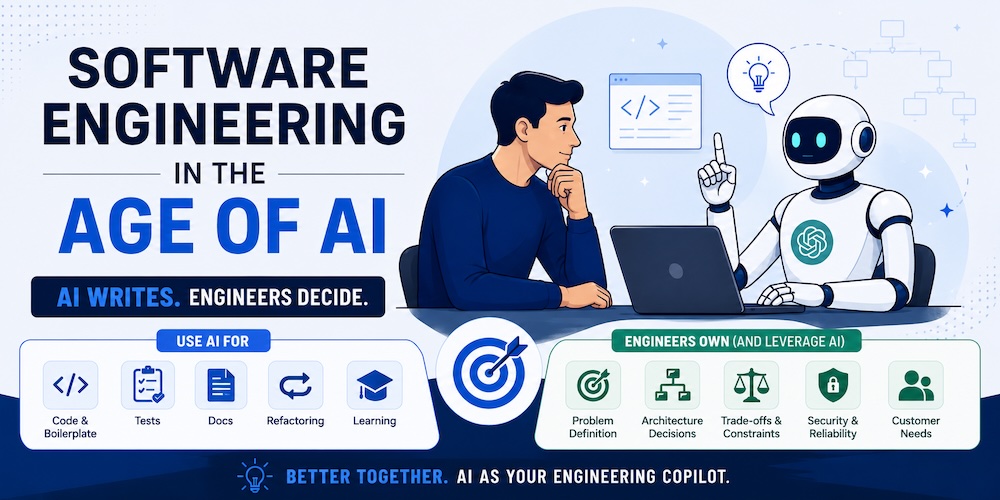
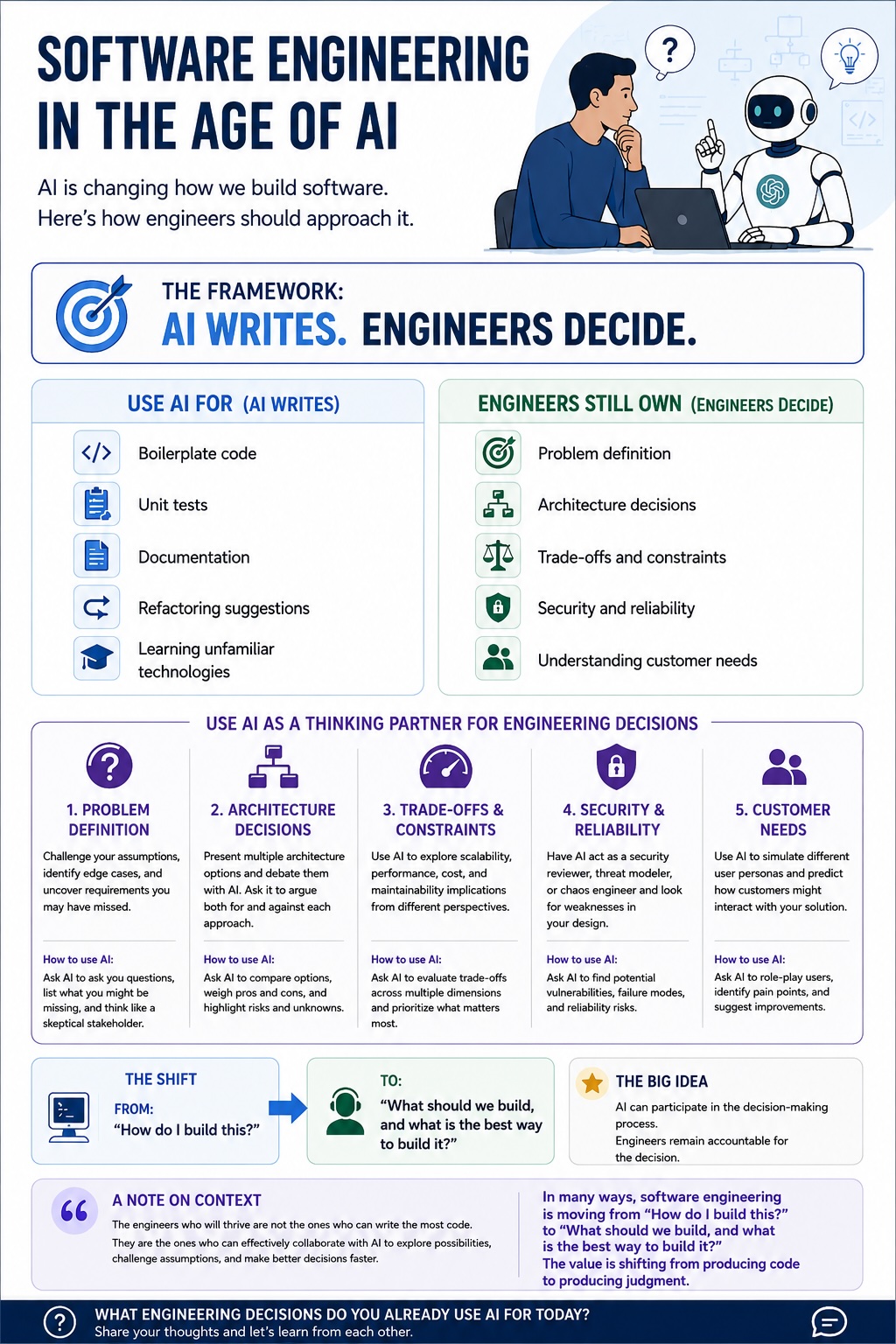
🔹 AI writes. Engineers decide.
Use AI for:
- ✅ Boilerplate code
- ✅ Unit tests
- ✅ Documentation
- ✅ Refactoring suggestions
- ✅ Learning unfamiliar technologies
But don't stop there.
The best engineers are also using AI as a thinking partner for engineering decisions.
📌 Problem Definition
Ask AI to challenge your assumptions, identify edge cases, and uncover requirements you may have missed.
📌 Architecture Decisions
Present multiple architecture options and debate them with AI. Ask it to argue both for and against each approach before making a decision.
📌 Trade-offs & Constraints
Use AI to explore scalability, performance, cost, and maintainability implications from different perspectives.
📌 Security & Reliability
Have AI act as a security reviewer, threat modeler, or chaos engineer and look for weaknesses in your design.
📌 Customer Needs
Use AI to simulate different user personas and predict how customers might interact with your solution.
The difference is subtle but important:
AI can participate in the decision-making process. Engineers remain accountable for the decision.
The engineers who will thrive are not the ones who can write the most code.
They are the ones who can effectively collaborate with AI to explore possibilities, challenge assumptions, and make better decisions faster.
In many ways, software engineering is moving from:
"How do I build this?"
to
"What should we build, and what is the best way to build it?"
The value is shifting from producing code to producing judgment.
Comments