Over the last few months, AI has started writing a significant portion of the code in my day-to-day work.
Functions, APIs, tests, refactoring—even entire features can now be generated in minutes. Naturally, this has led to a lot of discussion about what engineering teams will look like in the AI era.
Recently, I came across Andrew Ng's prediction that AI could push organizations toward a developer-to-product-manager ratio of around 0.5:1.
The idea is simple: if AI writes most of the code, organizations will need fewer developers and more people defining requirements.
On paper, that makes sense.
But after spending months building real products with AI, I think the bigger shift is happening somewhere else.
AI Didn't Remove the Hard Part
AI has dramatically reduced the effort required to write code.
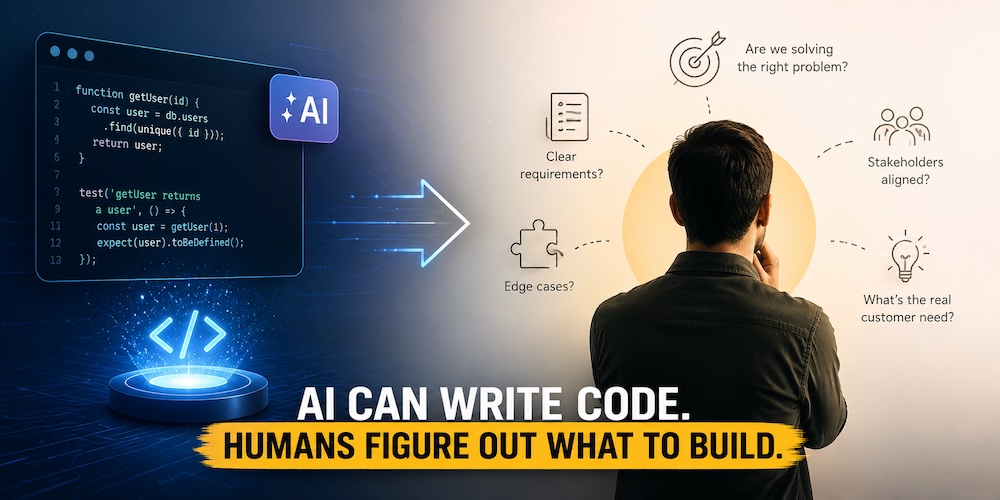
What it hasn't reduced is the effort required to answer questions like:
- Are we solving the right problem?
- Did we understand the requirement correctly?
- What happens in edge cases?
- Are product, engineering, and stakeholders aligned?
In fact, AI has made these questions more important.
When implementation takes minutes instead of weeks, unclear requirements become obvious almost immediately. The bottleneck has shifted from writing code to understanding what should be built.
A Simple Example
Imagine the requirement is:
"Users should be able to cancel their subscription."
AI can generate the APIs, database changes, UI, and tests in minutes.
But the real questions begin after that.
- Is cancellation immediate or at the end of the billing cycle?
- Does the user receive a refund?
- What happens to premium features?
- Should data be deleted?
- What about enterprise customers or users on a free trial?
These aren't coding problems.
They're business decisions.
And no AI can invent the correct answers because they depend entirely on the product and the organization.
Do We Really Need More PMs?
A common conclusion is:
Less coding = More product managers.
I'm not convinced.
Adding more PMs doesn't automatically create more clarity. In many organizations, it simply creates more meetings, more documents, and more communication paths.
The real challenge isn't writing requirements.
It's building a shared understanding across the team.
The Engineers Who Will Stand Out
As AI continues to automate implementation, the engineers who create the most value won't necessarily be the fastest coders.
They'll be the ones who:
- Understand the business deeply
- Challenge assumptions
- Ask the right questions
- Identify missing scenarios
- Help teams solve the right problem—not just implement a solution
AI can generate code.
It still can't replace judgment, context, or product thinking.
Final Thoughts
Andrew Ng's prediction may well be true for some organizations, and AI will undoubtedly change team structures.
But I don't think the future is simply "fewer developers and more PMs."
I think it's a future where the line between engineering and product thinking becomes increasingly blurred.
As coding becomes cheaper, understanding the problem becomes the real competitive advantage.
The engineers who thrive won't be those who type the fastest.
They'll be the ones who ask the questions that prevent the team from building the wrong thing.
Comments